Blog

Human Skeleton Analysis and Kinematics

The team focuses on the mathematical modeling of human movement and the automated extraction of biometric data from skeletal sequences, primarily utilizing depth sensors (e.g., Microsoft Kinect).

Key Research Focus

  • Kinetic Motion Analysis: Development of algorithms for real-time tracking of joint trajectories. This includes evaluating gait stability, limb range of motion, and detecting motor anomalies.
  • Robust Data Filtering: Utilizing advanced statistical methods and filters (e.g., Kalman filters) to mitigate sensor noise, ensuring accurate 3D skeletal reconstruction even in non-laboratory environments.
  • Postural Assessment: Automated evaluation of posture to identify asymmetrical movement patterns that may indicate underlying neurological or orthopedic conditions.
  • Activity Recognition: Implementing machine learning models to classify types of movement and daily activities (ADL), supporting applications in elderly care and Ambient Assisted Living.
Karel Ĺ tĂ­cha

Karel Ĺ tĂ­cha (LinkedIn) received his Ing. degree from the University of Chemistry and Technology in Prague, Czech Republic. He is currently a PhD student and an assistant at the Department of Mathematics, Informatics, and Cybernetics at the University of Chemistry and Technology in Prague. His work focuses on programming, data analysis, and database systems.

Facial Nerve Function Analysis and 3D Modeling

Key Research Focus

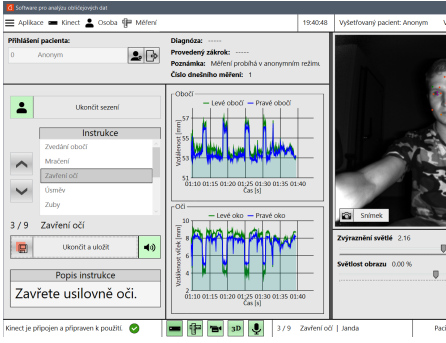
The team develops automated systems for the objective evaluation of facial nerve disorders (facial palsy) using 3D imaging technology and artificial intelligence.

  • Objective Parameterization: Replacing subjective clinical scales with precise 3D measurements of mimetic muscle movement, often utilizing cost-effective sensors like the Microsoft Kinect.
  • Deep Learning & CNNs: Implementing Parallel Convolutional Neural Networks to automatically classify the degree of facial impairment by analyzing both global facial symmetry and local muscle dynamics.
  • Rehabilitation Monitoring: Statistical analysis of facial kinetics during therapeutic exercises to track recovery progress and the effectiveness of surgical interventions.
  • Medical Integration: Collaborating with clinical experts to provide surgeons and therapists with data-driven insights into post-operative healing and muscle function.

Jan Mareš

Jan Mareš (LinkedIn) received his MSc and PhD degrees in technical cybernetics at the University of Pardubice, Czech Republic. He works as a full professor of signal and image processing in the Department of Computing and Control Engineering, University of Chemistry and Technology, Prague. His research is focused on biomedical data processing for early diagnosis.

Jan Kohout

Jan Kohout (LinkedIn, ORCID) recieved his MSc at Czech Technical University, Faculty of Electrical Engineering, and his PhD degree in technical cybernetics at the University of Chemistry and Technology, Prague, Czech Republic.

He serves as an Assistant Professor at UCT Prague, where his primary passion lies in pedagogy. He strives to explain technical and IT principles clearly, foster independent thinking, and motivate students to seek broader contexts. He is deeply interested in motivation, psychology, and supporting the personal growth of his students.

His lifelong motto is that “technology should serve people, not people technology.”

He enjoys music, intelligent humor, and helping others move forward. Professionally, he specializes in signal and image processing, as well as the preprocessing of biomedical data. He earned his Master’s degree (Ing.) from the Faculty of Electrical Engineering at CTU and his PhD in Technical Cybernetics from UCT Prague.

🌍For Internship

Join OptimCyb Research Group for an Exciting Internship Experience!

Are you passionate about interdisciplinary research that bridges chemistry, engineering, artificial intelligence, and signal processing? At OptimCyb, we are at the forefront of cutting-edge research, combining chemical engineering, AI, machine learning, and mathematical modeling to solve real-world problems.

We invite international students to be part of our dynamic and innovative team at the University of Chemistry and Technology, Prague. Our internship program offers hands-on experience in a world-class research environment, working on groundbreaking projects in areas such as:

  • Biomedical signal processing
  • Mathematical modeling of complex systems
  • AI-driven chemical process optimization
  • Data analysis and machine learning applications

What We Offer:

  • Mentorship by experienced researchers and professors.
  • Access to state-of-the-art laboratories and resources.
  • Collaborative, multicultural environment in the heart of Europe.
  • Opportunities to publish your research and attend international conferences.
  • Experience the vibrant city of Prague, rich in culture, history, and student life.

Who Can Apply?

We welcome students from diverse academic backgrounds, including:

  • Chemical engineering
  • Biotechnology
  • Computer science and AI
  • Mathematics and physics

This internship is a perfect opportunity for students seeking to expand their research skills, work on real-world challenges, and make valuable professional connections in the scientific community.

Links

🧑‍🎓For Undergraduates

Why is it important to choose your thesis topic early?

Choosing your bachelor’s thesis topic early can make a huge difference in your academic journey.

Here’s why:

  1. More creativity – Starting early gives you time to explore different fields and find a topic that truly interests you, keeping you motivated.
  2. Linking to internships – An early decision allows you to connect your thesis with hands-on experiences from labs or internships, making your work more practical and valuable.
  3. Better time management – With more time, you can plan efficiently, consult with supervisors, and avoid last-minute stress.
  4. Join real research – Early choice secures your spot in exciting research projects, often collaborating with leading experts.

Overview of Bachelor’s and Master’s Theses

Our research group, OptimCyb at the University of Chemistry and Technology in Prague, provides students with opportunities to work on cutting-edge interdisciplinary projects. Our students tackle contemporary challenges at the intersection of chemical engineering, artificial intelligence, signal processing, and mathematical modeling.

Below is a sample of Bachelor’s and Master’s thesis topics addressed within our group:

Bachelor’s Theses

  • Optimization of Chemical Processes Using Machine Learning
    • The goal of this thesis is to develop predictive models for optimizing manufacturing processes in the pharmaceutical industry using machine learning algorithms.
  • Analysis of Biological Signals Using Advanced Data Processing Techniques
    • This work focuses on applying modern signal analysis methods in medicine, including pattern recognition in biological data.
  • Modeling Mass and Energy Transfer in Bioreactors
    • This project involves mathematical modeling of processes in bioreactors to improve the efficiency of industrial bio-pharmaceutical production.

Master’s Theses

  • Development of Predictive Models for Personalized Medicine
    • The thesis focuses on creating models that predict treatment effectiveness for individual patients based on their genetic and biological data.
  • Machine Learning for Quality Control in Chemical Engineering
    • This project deals with the development of machine learning systems that automate quality control processes in chemical industry manufacturing plants.
  • Simulation of Dynamic Systems in Chemical Processes
    • This thesis is dedicated to advanced simulations of dynamic systems in chemical engineering to optimize operational parameters.

Links